
Do You Like Our Owl?
An Immersive Room Cosplay of Dr. Tyrell’s Pyramid Office

One day the idea struck me like a bolt of lightning. Although, it’s probably more accurate to say there was a slow-burning fuse that I didn’t quite realize. It started with this classic art deco home theater, originally designed by a screenwriter a couple of homeowners ago. As I got to work on the restoration, modernizing the electronics, I also designed and installed acoustic treatments and light absorbing panels. This helped to better isolate only the light and sound intended by the filmmakers. After letting that all sit for a while, it hit me that these features make the room as much a soundstage to create scenes, as a room for viewing movies. Given that existing art deco look, and my own obsessions with prop replicas and home automation, I realized I was already part of the way there to breathe life into Dr. Tyrell’s pyramid penthouse office from Blade Runner. Now, I realize that sentence probably reads like magical thinking, so let me pause on the explanation and just show you what I mean.
First, here's the scene from the movie via YouTube:
Now here’s what the theater looks like normally:
And here’s what happens when I turn on the Tyrell automation:
The anchor for all this is that I can make one wall anything I want, since it’s virtually matched in size and shape with a CinemaScope screen, and paired with the fidelity of a 4K HDR laser projector. So what you see is the view out of Dr. Tyrell’s office on the projector screen. The theater lights are dimmed and color-matched to the sunset in the image. The music is the Vangelis track that plays during that scene in the film.
A water effects projector points at the back wall from the video projector enclosure, and displays a water caustics visual, the rippling pattern of light you see when light refracts through water, similar to that seen in the interior perspectives into Tyrell’s office.
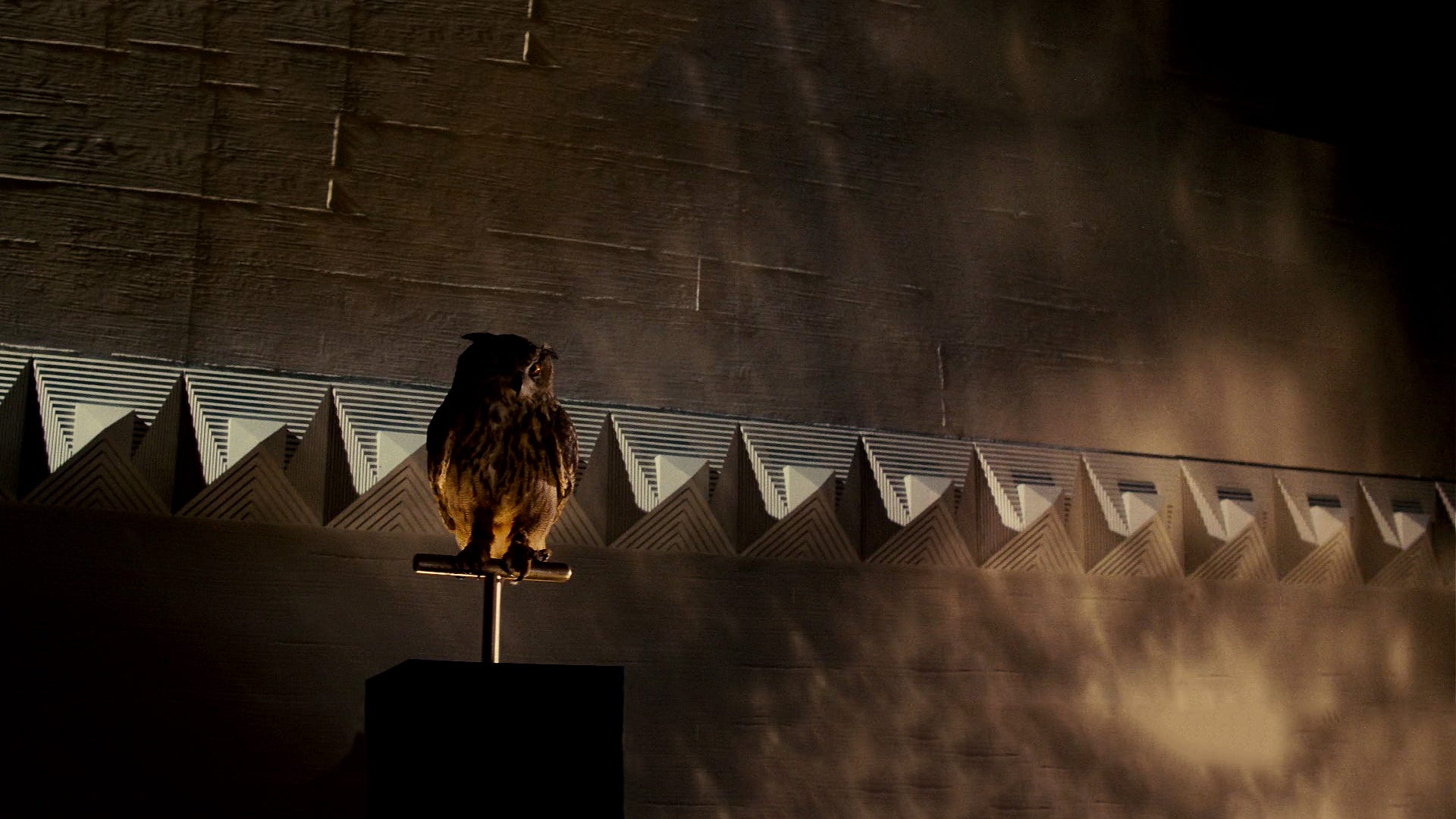
This water caustics effect was recreated in Wallace’s offices in the magnificent Blade Runner 2049 as well. This film resurfaced interest in this visual, and the r/Filmmakers subreddit has a lot of brainstorming on how to create it. I got the ADJ H20 projector on a recommendation from here.
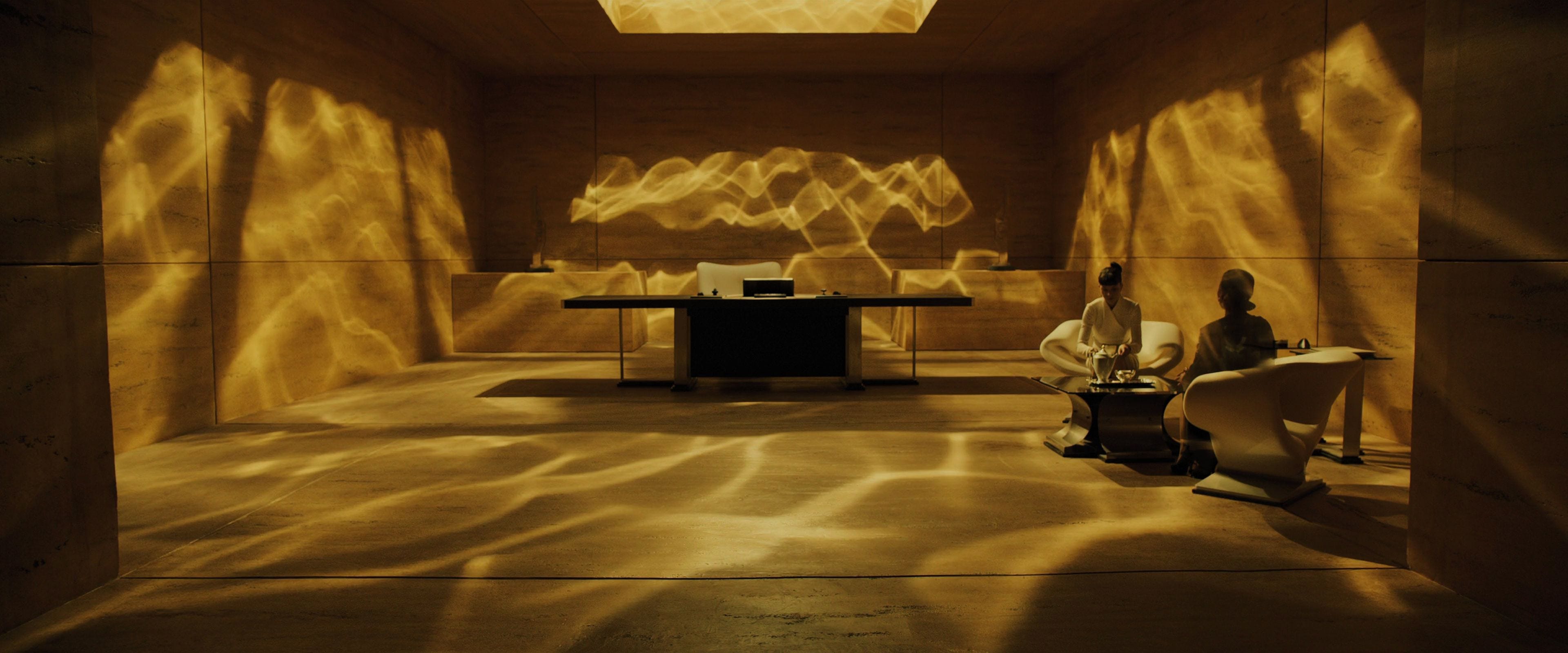
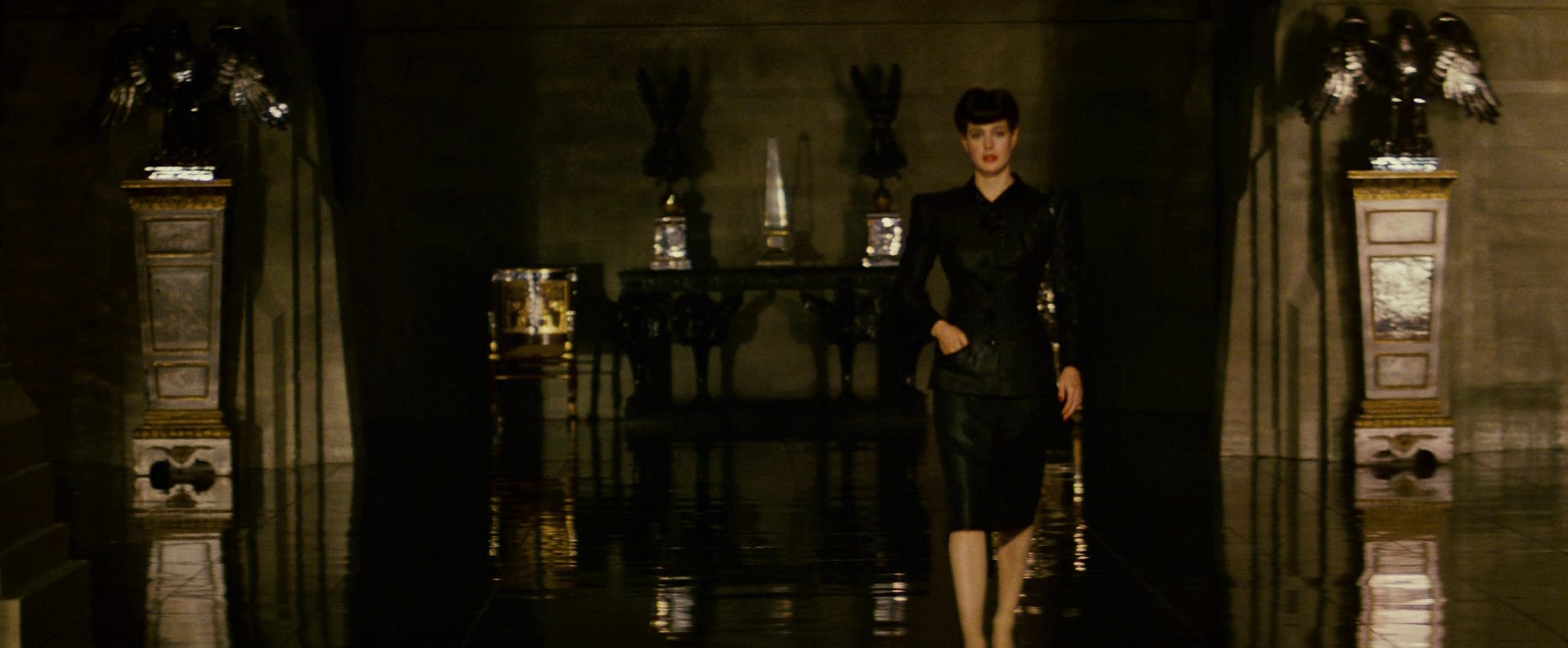
In terms of the props themselves, I’m taking much more of a home-made costume cosplay approach, where I focus attention on film-accurate elements under spotlights, and leave the almost impossible elements to be approximate likenesses in reduced light. There’s really no practical way I can duplicate the grand scale of the space, for example its giant stone columns, or even Tyrell’s lavish collection of museum-caliber statues and urns.
But I can focus on what director Ridley Scott focuses on, how he composes his shots, the objects on the conference table where Deckard performs the Voight-Kampff test on Rachael. I’ve laid them out on the bar of the theater arranged just as they are in the scene. These objects are a silver and crystal 1940s Topazio claret jug, a 1980s Laslo for Mikasa glazed Japanese plant pot, and a Juniper bonsai in a vintage rectangular bowl.
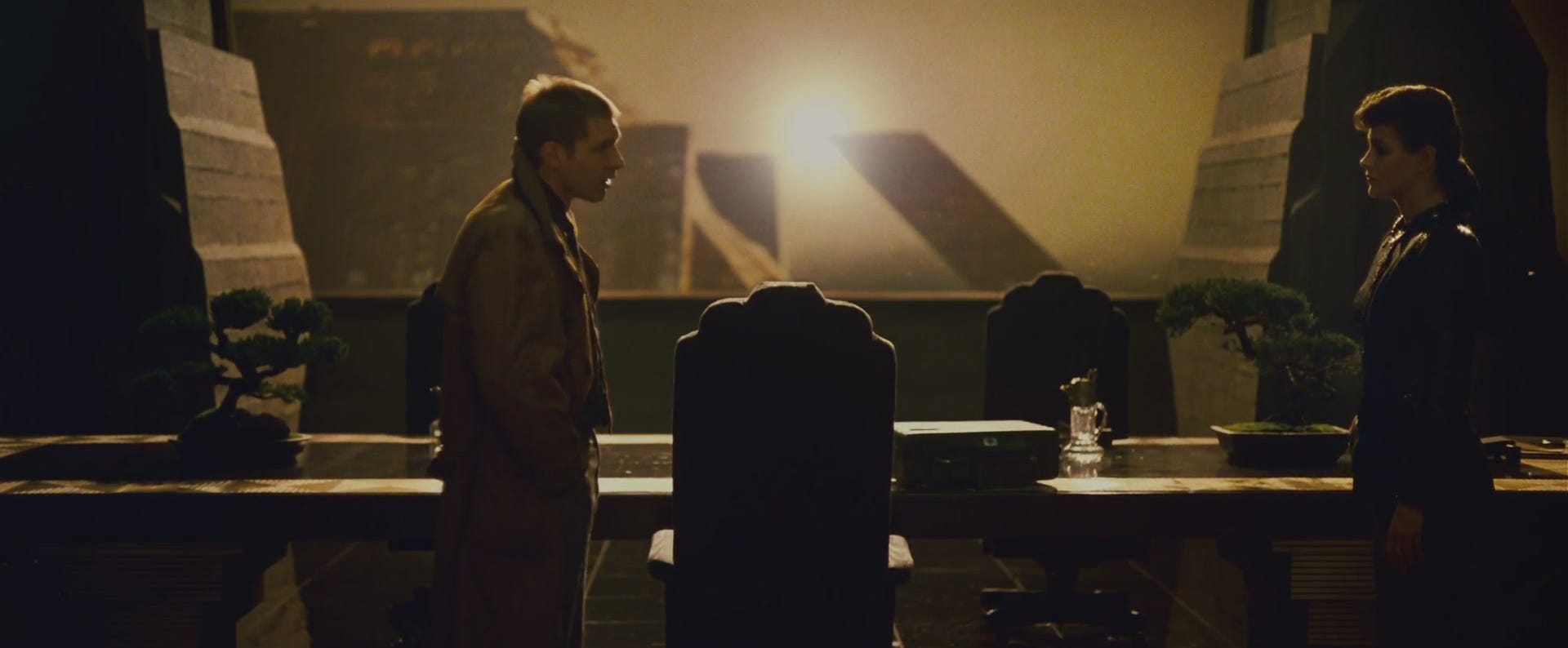
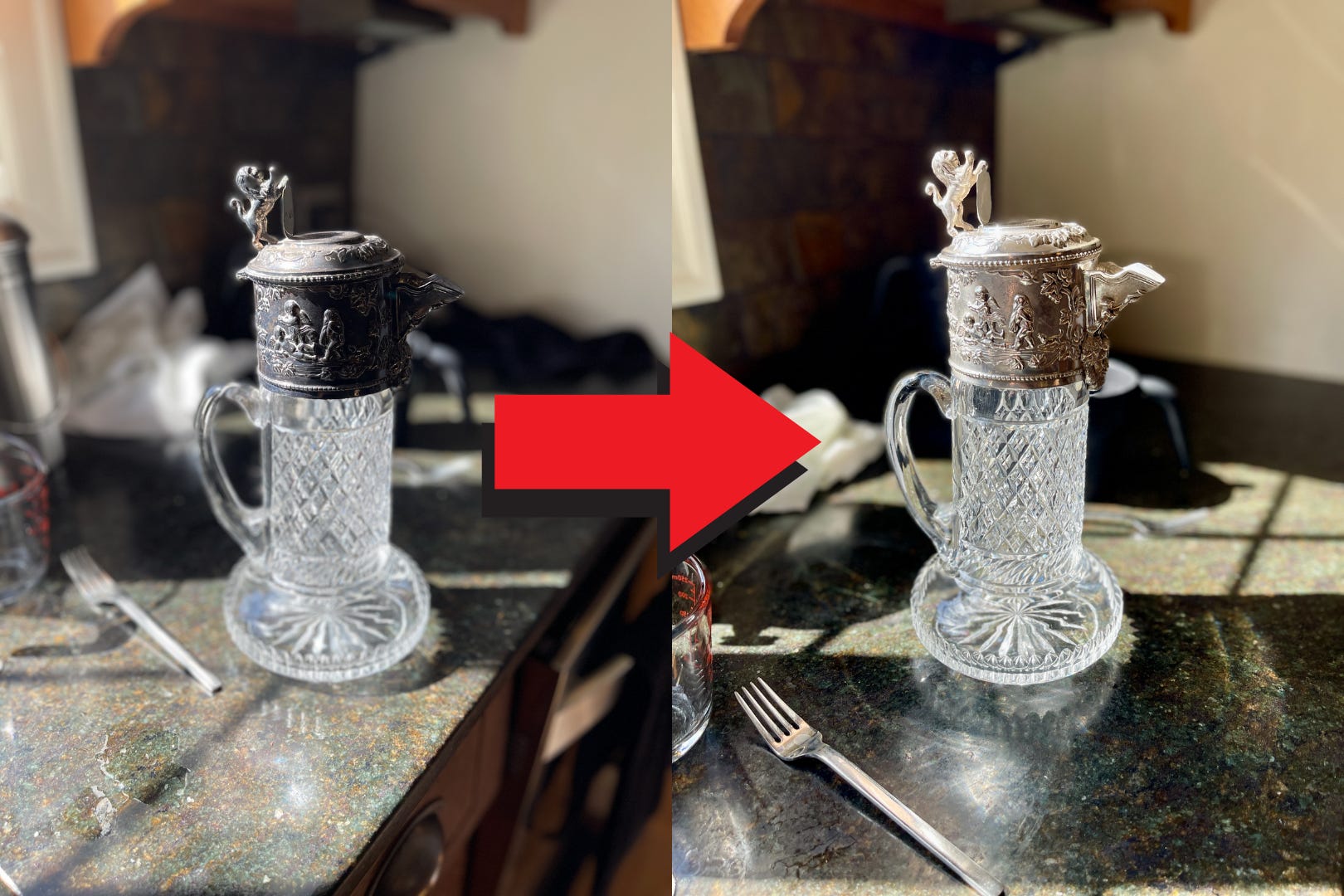
These pieces are the holy trinity of the Tyrell set for Blade Runner prop hunters, and the claret jug is the most distinctive. Given that it was a luxury item even when it was made, it’s not easy to obtain. Like the Graflex flash handle used in the original Star Wars lightsabers, sellers typically do know the relevance of what they have. Again, I had an eBay search saved to find this item at a reasonable price. This time, it only took a couple of months for one to appear, but it was tarnished almost to black. It didn’t really look like Tyrell’s jug. But, I figured this is part of the adventure, and I had an idea. I worked out a price and got this precious piece of history in my hands. Unlike the Graflex, I did want to remove the staining, so I researched the classic methods of removing tarnish from silver. I settled on aluminum foil, baking soda, and my largest cooking pot. It did feel a bit risky, to chemically alter a still expensive and rare item, using processes I’d never tried before. It was like drilling and riveting into the Graflex. But thankfully, the process worked — and I safely ended up with a pristine Topazio jug that looked like versions selling for prices I didn’t want to spend. Phew!
The 1980s Mikasa pot was a bit more straightforward, in terms of being just outright blocked for the exact item. I couldn’t even find the fully black version available at any price. But I did find a partially black one with a brown glaze across the top, which looked really striking to me. Like a Shigaraki vase, which I’ve both collected and given as gifts on special occasions.
The bonsai needed work. I can’t keep plants alive, so I researched artificial bonsai. Wonderfully, I could economize here too, since I found one inexpensive Juniper one on Amazon that had glowing reviews. I figured Amazon is very low risk, and when it arrived I was astonished at how realistic the bonsai was. I shaped it, and repotted it to resemble Tyrell’s Juniper. The bigger challenge was finding a rectangular Tokoname bonsai pot, in a dark brown or gray color, which is surprisingly harder than it seems. I eventually found a close match on a Japanese antique pottery website. This find had what looked like a large white chip on the side, but it was otherwise exactly right. And the defect probably accounted for it being weirdly inexpensive for a 1930s pot. It arrived, looked great, and once all assembled, looked exactly right. Amazingly, my daughter noticed that the white chip was convex and not concave, and being a budding artist, speculated that it could be a stray brush stroke of acrylic paint. A few minutes of gentle rubbing with nail polish remover, and it was gone. The prop trinity was ready for action.
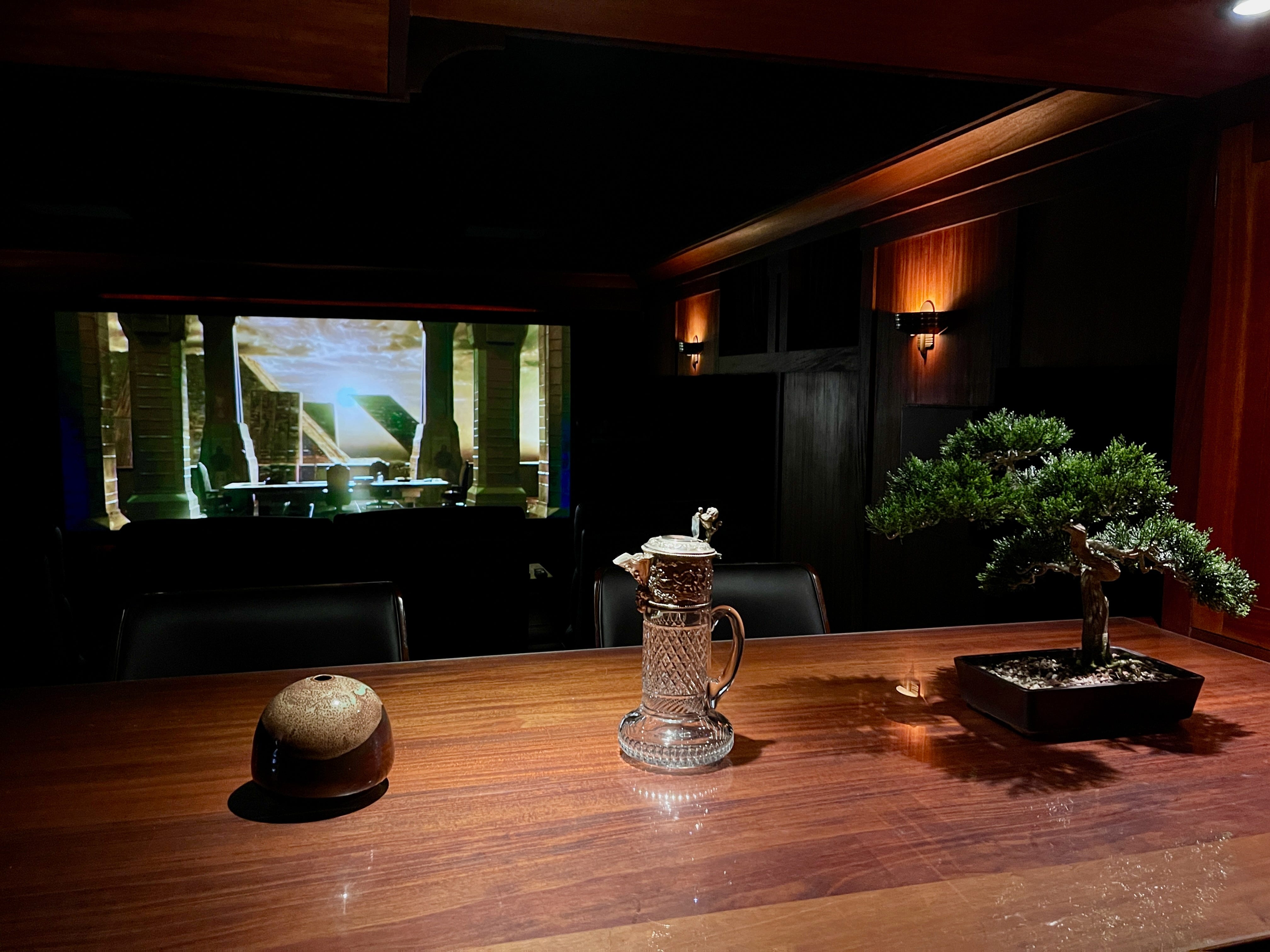
For Tyrell’s lavish sculptures, I went for approximations in the flickering shadows cast by the effects projector. Instead of giant bronze cubist eagles and large bronze urns, I simply display my existing replica Canopic jars, housing the remains of my dear feline companion. This step does merge several different props together, but they suit me and seemingly also the pharaonic theme of Tyrell’s world.
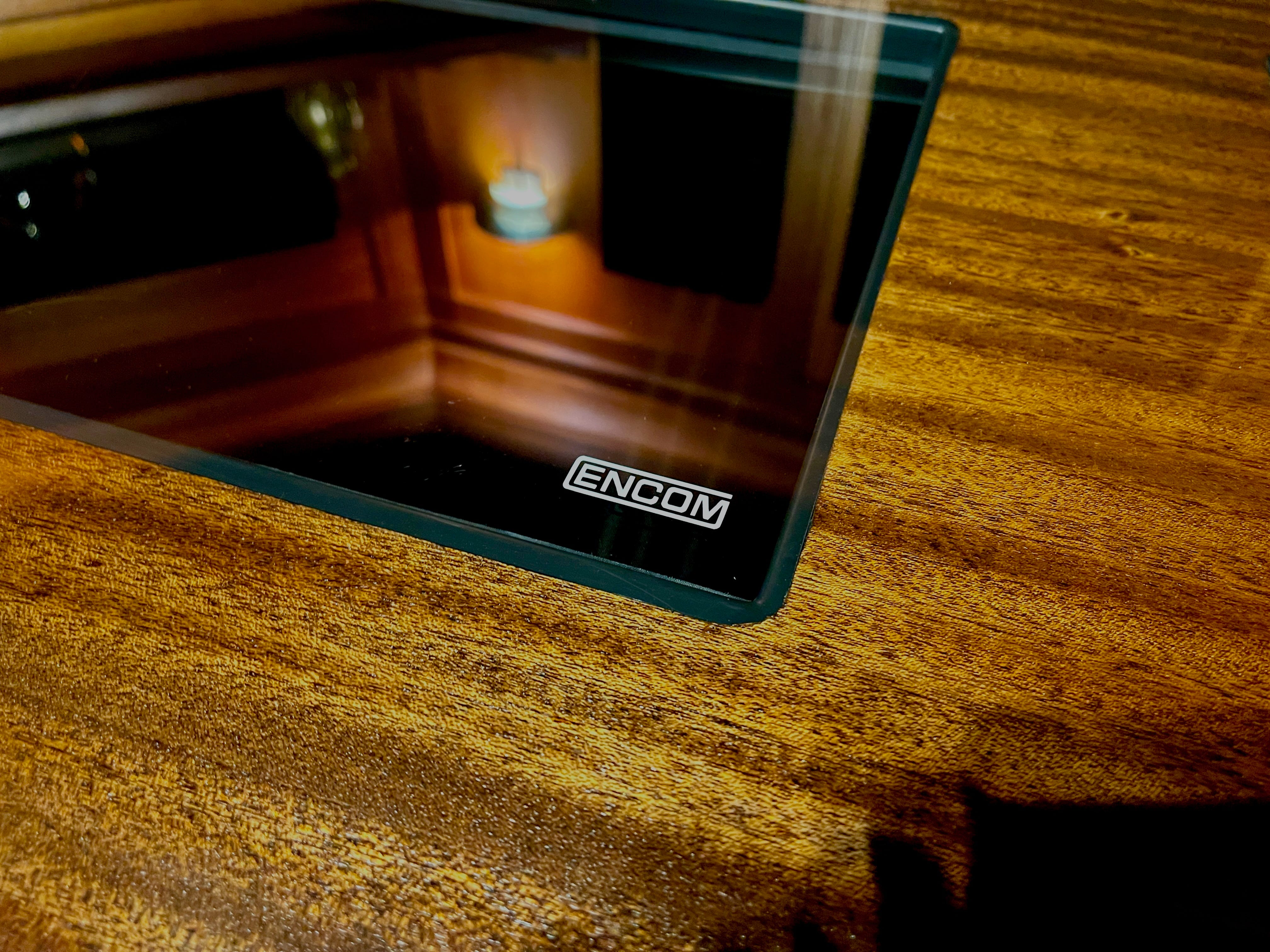
Speaking of existing objects, I had to do a bit of clean-up in the space. I have an arcade cocktail table toward the back of the room, which doesn’t really belong in Tyrell’s office. I didn’t want to just remove it though, I do enjoy it as do my kids and guests. But it occurred to me that I could dress it up so it would fit in. I removed the vinyl arcade graphics underlay from under the glass top, and used it as a stencil to hand cut a sheet of mahogany veneer. I stained and sealed it to match the mahogany walls, and then placed that under the glass. I toyed with placing an Atari decal under the glass while I was there, like the 1970s Asteroids tables, given the appearance of Atari logos in the films. However, I thought it would be more fun to tie in another fictional 1980s touchstone, the movie Tron. So I asked a vinyl decal artist to invert her existing Encom decal so it work adhere under glass, and it looks wonderful. While I was there I made my own fine print decal for the control panel, to help players understand the risks they incur by trying to hack the Encom code.
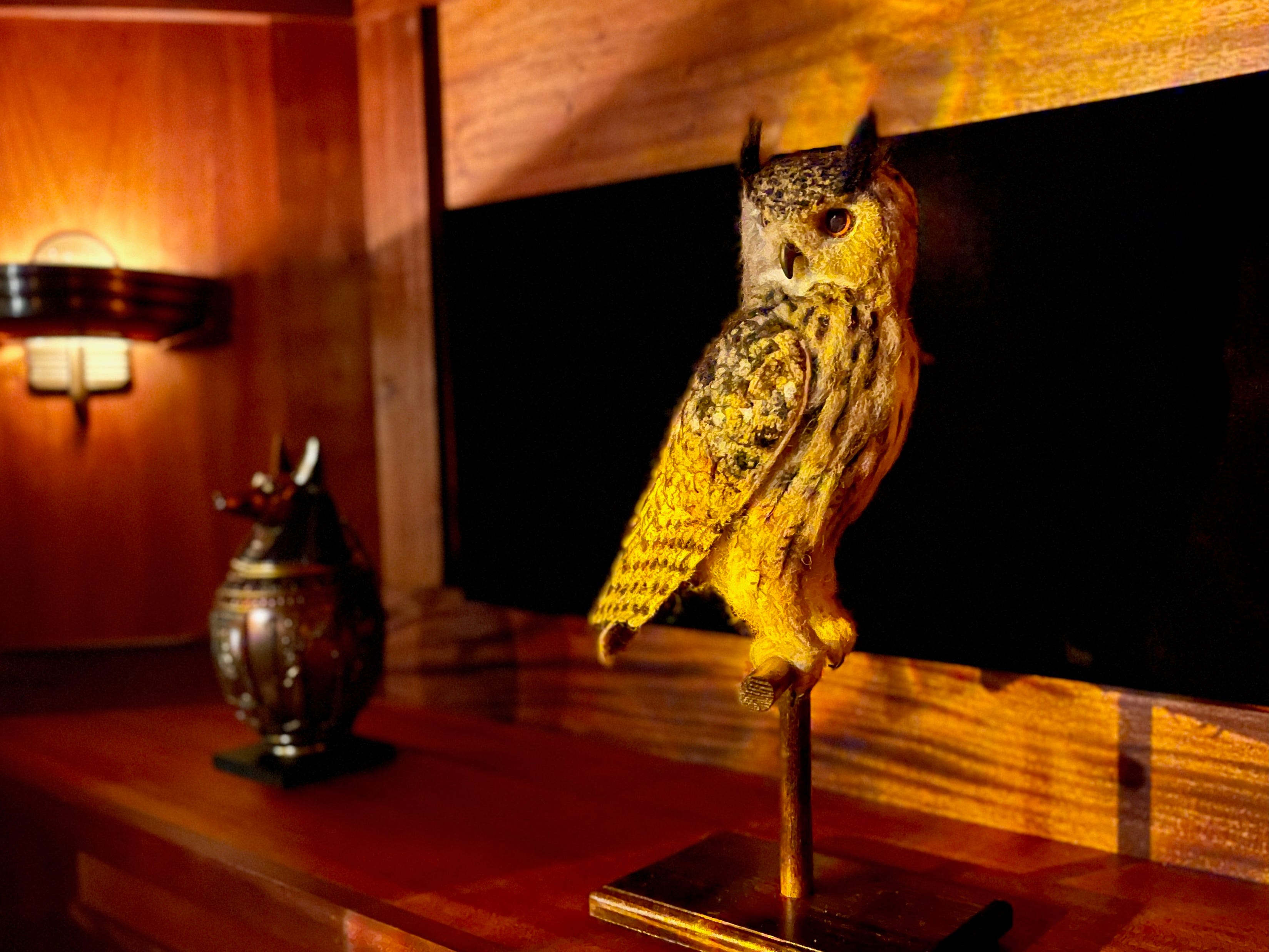
As I write this out, it sounds like I got a little carried away on that tangent, but I really did have my eye on the prize as well. So let’s talk about the owl. This couldn’t be something adjacent to the film, something that looks like a toy, like my son’s plush owl puppet. Eden the owl has real prominence and meaning in the scene. She’s an electronic Animoid, an artificial being. When she swivels her head to look to directly at Deckard, Deckard copies the move to swivel to look at Rachael, suggesting to me another subtle implication that Deckard too is a Replicant.
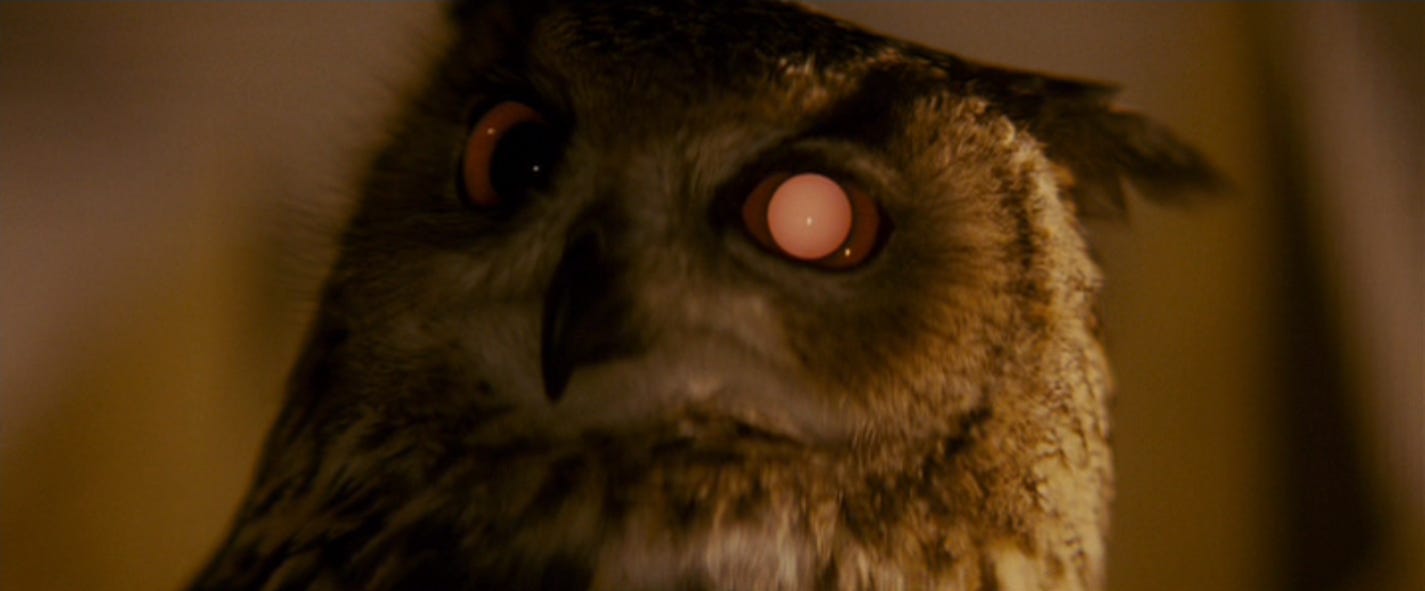
So Eden is important. The challenge was working through something in-between real and a toy. I’m not going to keep a live pet as a prop, or a dead one for that matter. Plus, in keeping with the film, it’s better for her to be artificial in some way. In researching ideas, I found a tufted wool artist with an incredible talent for making lifelike owls. I got in contact with her and described that I was hoping for a model of this specific Eurasian Eagle Owl shown in this scene, turning her head, with a glint in her eye. We had a bit of back and forth, and a few weeks later, this magical creature arrived. I gasped when I saw her, she does in fact look real, especially sitting on her perch in the controlled lighting. She is perfect.
Okay, so returning to the lighting, it’s worth sharing more detail on how these automations actually work. The idea for them came into focus all at once, which probably again sounds magical. However, I did have a head start, my mind was preconditioned for this automation snap to happen due to several factors. For one, I know and love Blade Runner. I love exploring what were the actual found objects used as props in that and other spellbinding science fiction films. I’ve also been a photographer and written and directed a few short films for the 48-Hour Film Project, so I’ve worked through setting up scenes. But critically, since I installed both HomeKit and Home Assistant in my home, they also installed themselves in me. I began to think in terms of triggers and automations. And the sequence for this new synchronized automation just snapped into being.
How this works is that I have an Apple Shortcut on my iPhone, that first triggers a custom screen saver of Tyrell’s giant window view, to display on the AppleTV in the home theater.
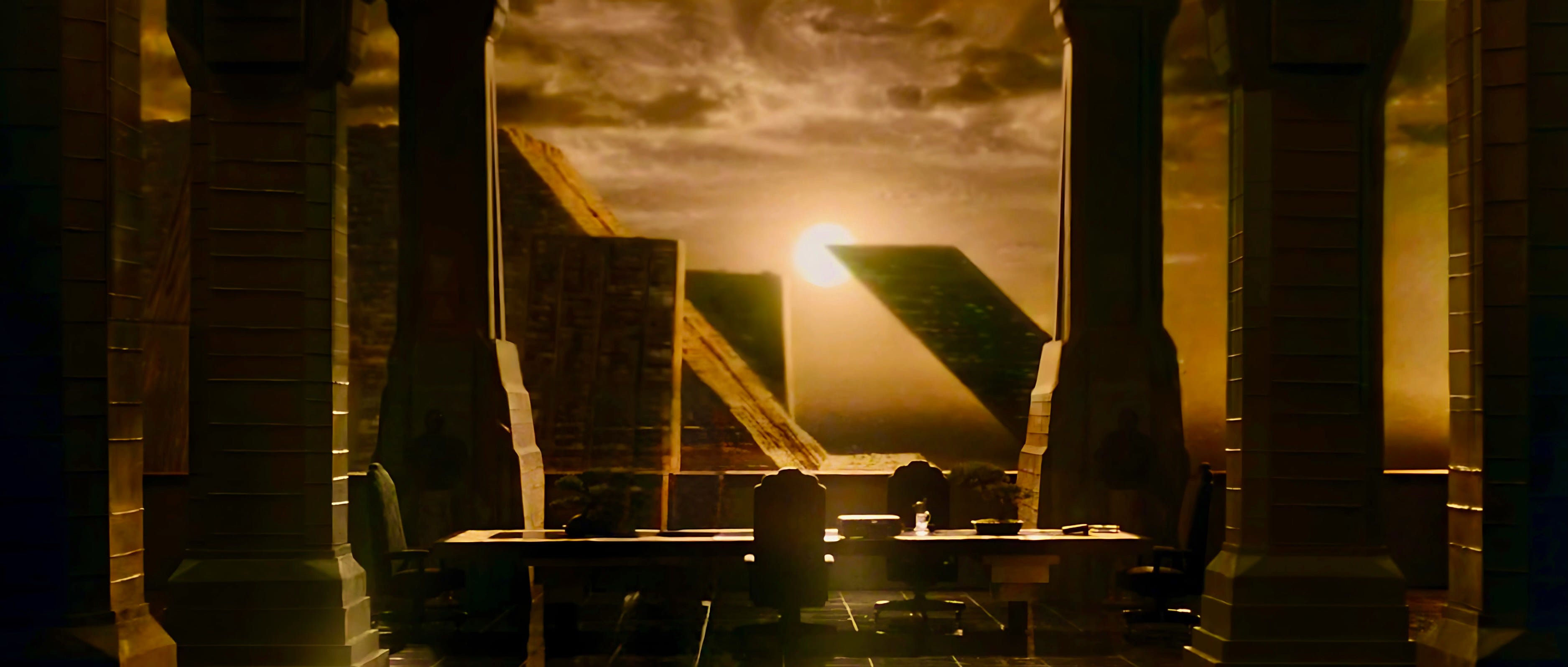
This started as a still image from the 4K disc of Blade Runner. I then cropped it to be mostly the view of the sunset and some foreground elements including the hero props. Next I ran it through Canva’s AI tools to magic-erase Deckard and the owl from the scene, double the overall resolution, and also process the colors and contrast, to interact well with the projector laser. I considered a closer crop of just the outside view, as well as an artist’s painting of the pyramid, but decided this composition did the best job of associating the image as a room, and blending on-screen objects with real in-room objects. Of course if I had access to a hi-res scan of the original matte painting, I would have much more to work with! Ahem. Anyway, I think this works better than anything else I’ve tried so far.
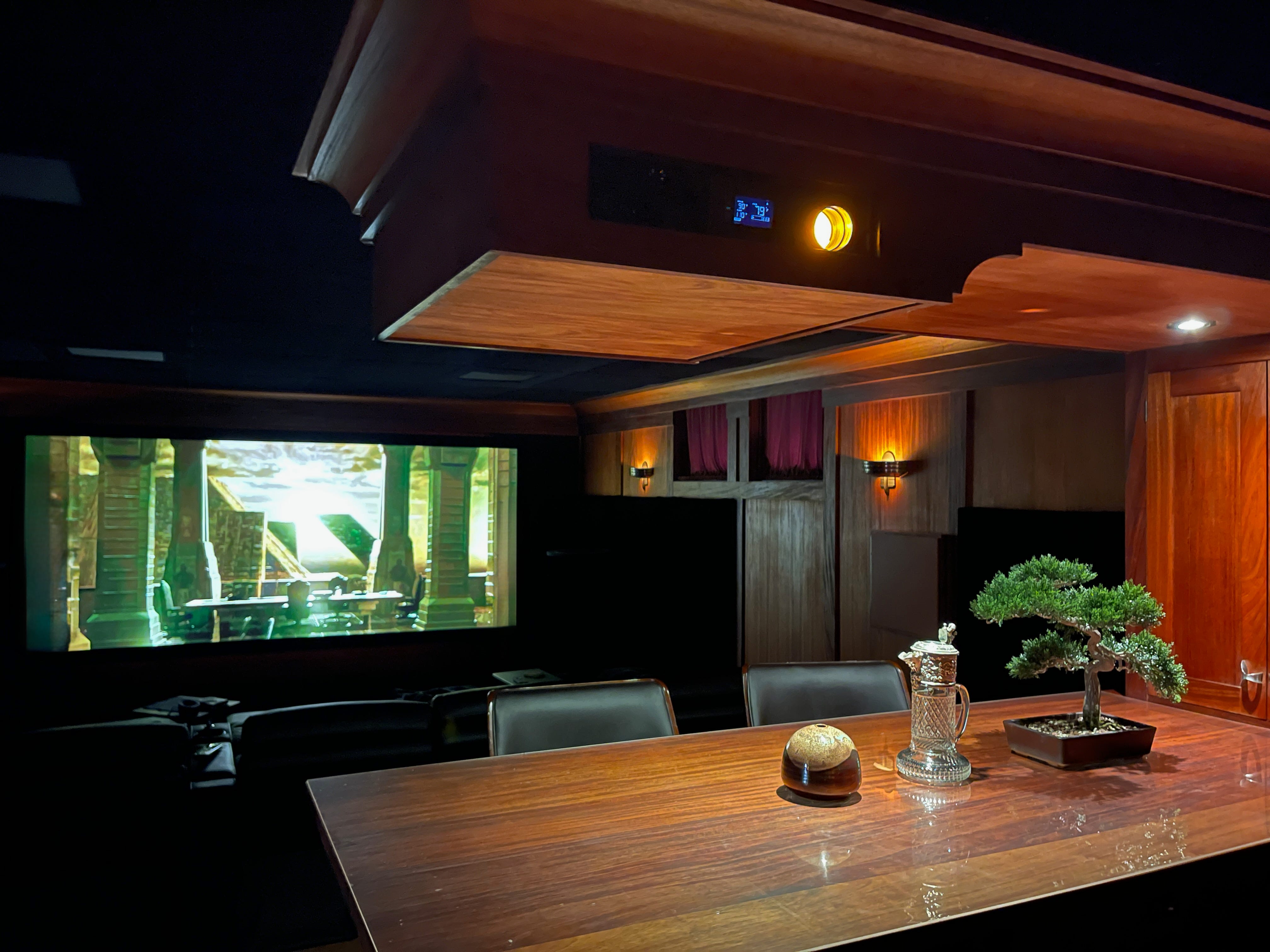
The same shortcut also activates a Hue plug in the projector enclosure that turns on the ADJ water effects projector. That’s the amber light in the top of the picture. It’s set to the matching color, pattern, and direction as seen in the film. The shortcut then plays the Dr. Tyrell’s Owl track on loop, through a closed theater-only HomeKit home, to a stereo pair of HomePod minis on opposite ends of the room. Home Assistant sees the Hue plug turn on, which triggers it to dial all the Lutron and Hue lights to match the color and brightness of the sunset light as shown in the room in the film.
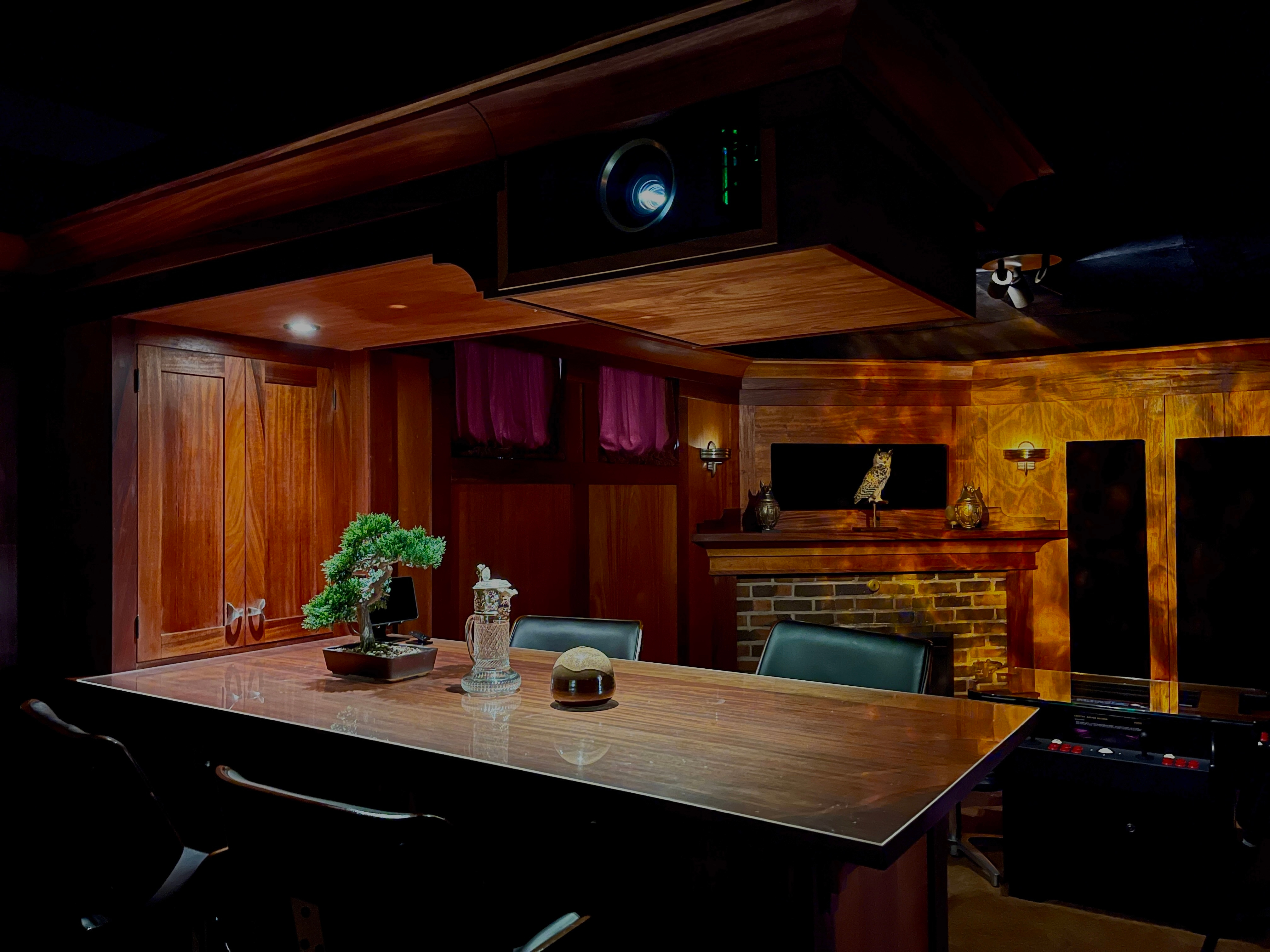
And then my wife steps forward and asks if you like our owl.
Well maybe not that last part, but I am working on my Eldon Tyrell cosplay next. And yes, I realize there’s space for a V-K machine right there too.
On that note, I don’t claim this is a 100% accurate set recreation of Dr. Tyrell’s lavish space. With what I’ve learned about the scale at which that scene was shot, that would essentially require more of a film production budget than the spare resources that I could cobble together on weekends for my more modest theater space. But once finding the minimum arrangement of key defining elements, it does feel amazing to be able to step into Blade Runner with the touch of a button, and then step back out with the touch of another.
I’m not sure this is what HomeKit and Home Assistant are intended for. I don’t see too much of this sort of thing on either the home theater or prop replica forums that I visit. The most I’ve come across is a Star Wars-themed theater with an emperor swivel throne in the back, and collections of props that live in the living room, or stay sealed inside acrylic cases. I couldn’t even figure out what to call this, since it’s not a full re-creation as done by the truly dedicated folks who rebuild a 100% accurate version of the bridge of the Enterprise, for example. Instead, given the very home-made parameters of this summer project, and the ability to put on and take off this look like a costume, I just ended up saying I cosplay my theater as Dr. Tyrell’s office. If anyone else out there also cosplays their spaces, I’d love to know.
As would my wife.
Resources
http://propsummit.com/
https://www.therpf.com/
https://www.avsforum.com/
https://www.reddit.com/r/Filmmakers/